Yen-Cheng Chang 張晏誠

University Excelsior Chair Professor of Finance

National Taiwan University · College of Management

Portrait of Yen-Cheng Chang

About

I am the University Excelsior Chair Professor of Finance at National Taiwan University, where I also hold the Chen Hong-Mo Chair in the College of Management and the SinoPac Holdings Chair in the School of Political Science and Economics. My research centers on behavioral finance and the econometric identification of causal effects in finance, accounting, and economics, with work appearing in the Journal of Finance, Review of Financial Studies (×2), The Accounting Review, Contemporary Accounting Research, and other leading journals. I currently serve as an Associate Editor at the Pacific-Basin Finance Journal and the Journal of Financial Studies.

Ph.D., Finance
University of Washington, Foster School of Business
M.S., Business Administration
University of Washington, Foster School of Business
M.A., Economics
Duke University
B.A., Foreign Languages & Literatures
National Taiwan University

Research Interests

  • Behavioral finance
  • Econometric identification
  • Disclosure & information environment
  • Investor behavior
  • Corporate governance

Selected Publications

  1. Regression Discontinuity and the Price Effects of Stock Market Indexing

    with Hong & Liskovich · Review of Financial Studies Cited by 525

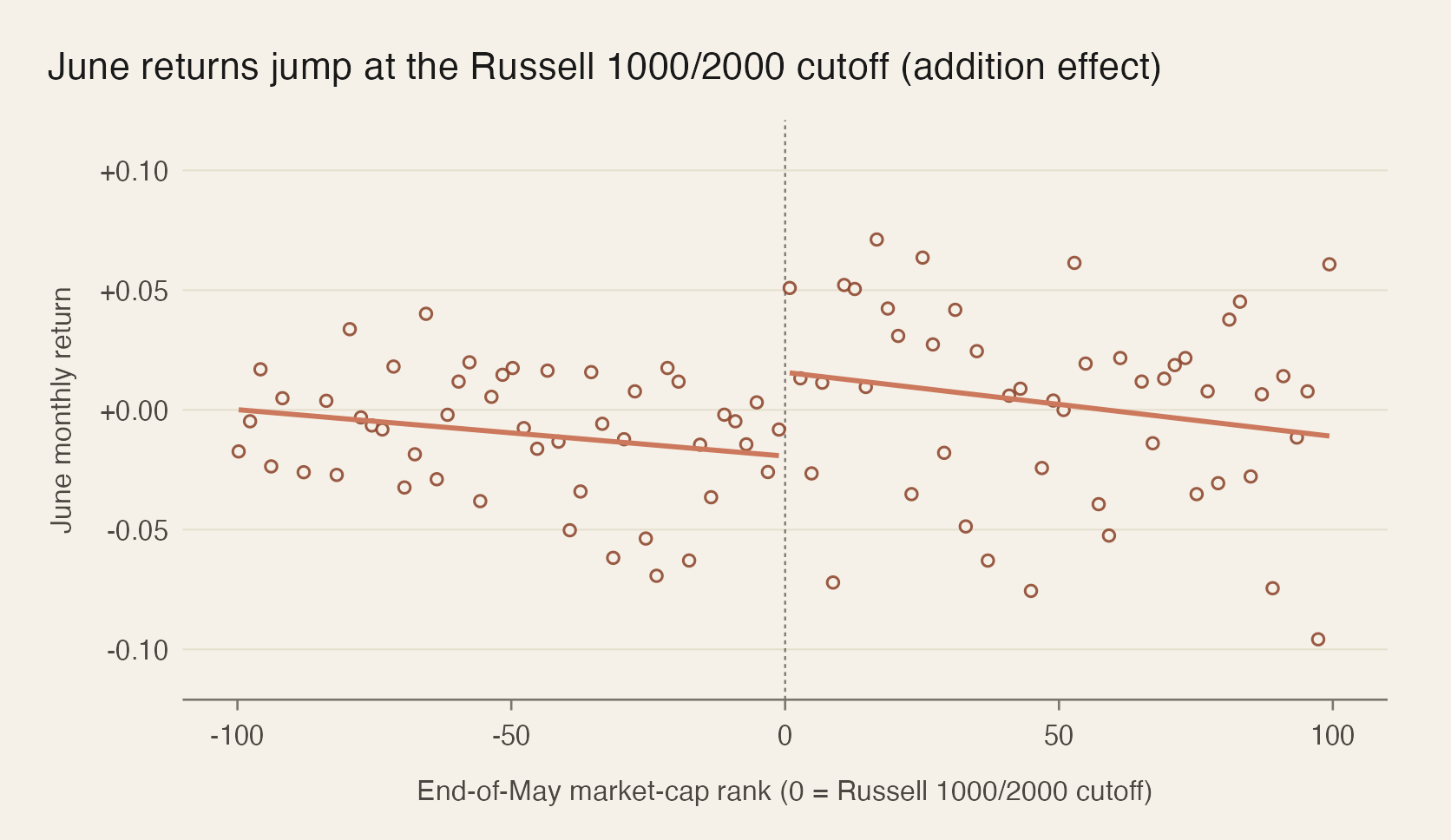
    Regression-discontinuity scatter plot of June monthly returns against the end-of-May market-capitalization rank around the Russell 1000/2000 cutoff. Points on the left (rank < 0) belong to firms that stay in the Russell 1000; points on the right are firms that cross into the Russell 2000. Separate linear fits on each side show a discontinuous upward jump at the cutoff.

    Using a regression-discontinuity design around the Russell 1000/2000 cutoff, we find clean five-percent price effects for both additions and deletions, concentrated entirely in the month of index reassignment and symmetric in size.

  2. Testing Disagreement Models

    with Ljungqvist, Hsiao & Tseng · Journal of Finance Cited by 101

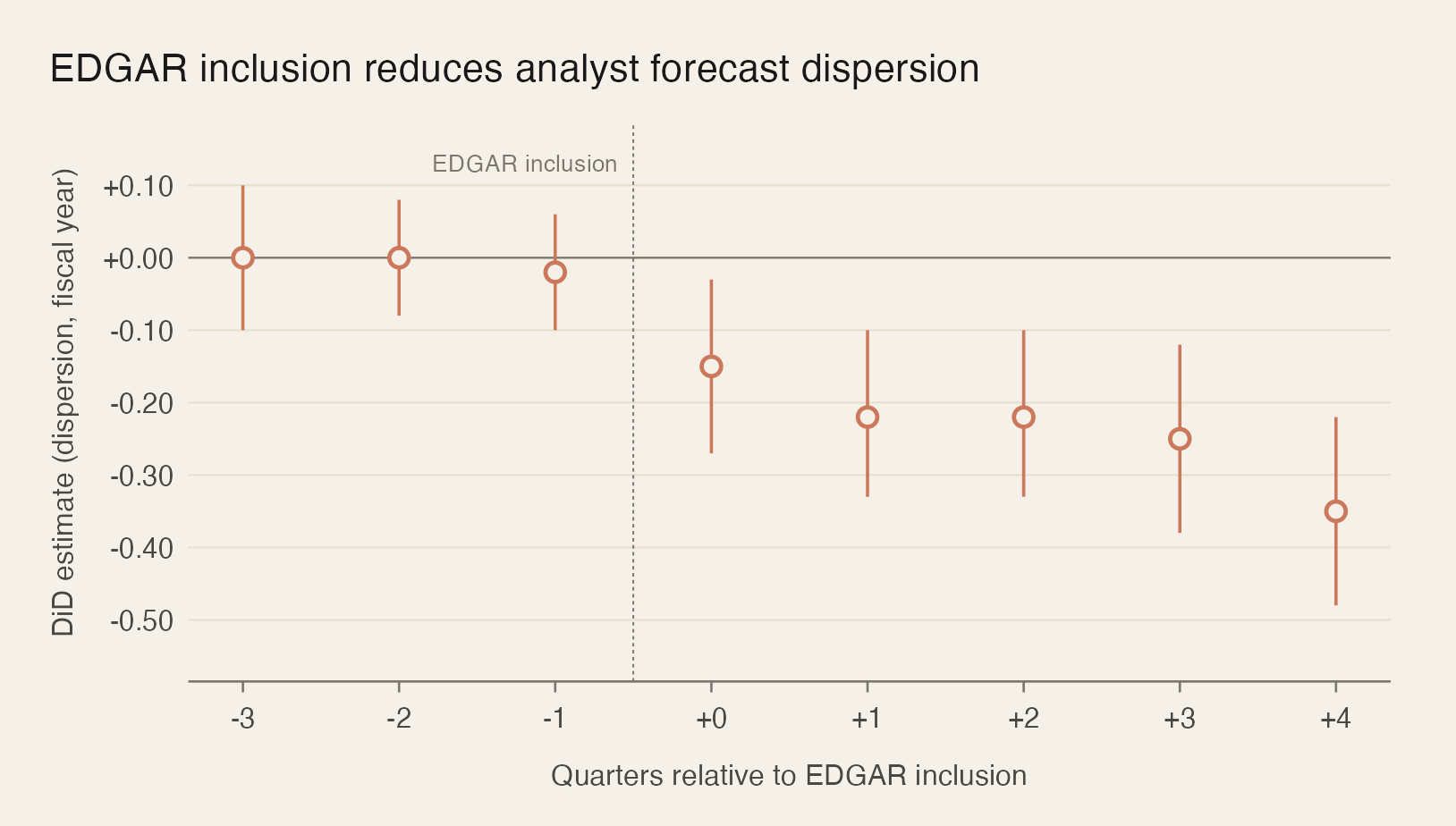
    Dynamic difference-in-differences estimates of EDGAR inclusion on the standard deviation of analysts' fiscal-year EPS forecasts. Pre-period estimates hover near zero; post-period estimates fall sharply, with each post-treatment confidence interval excluding zero.

    Investor disagreement is a key ingredient of overvaluation and crash risk: when corporate filings become easier to access and investors can reconcile their views, overvalued stocks correct and the risk of sudden price crashes falls.

  3. Do Corporate Disclosures Constrain Strategic Analyst Behavior?

    with Ljungqvist & Tseng · Review of Financial Studies Cited by 73

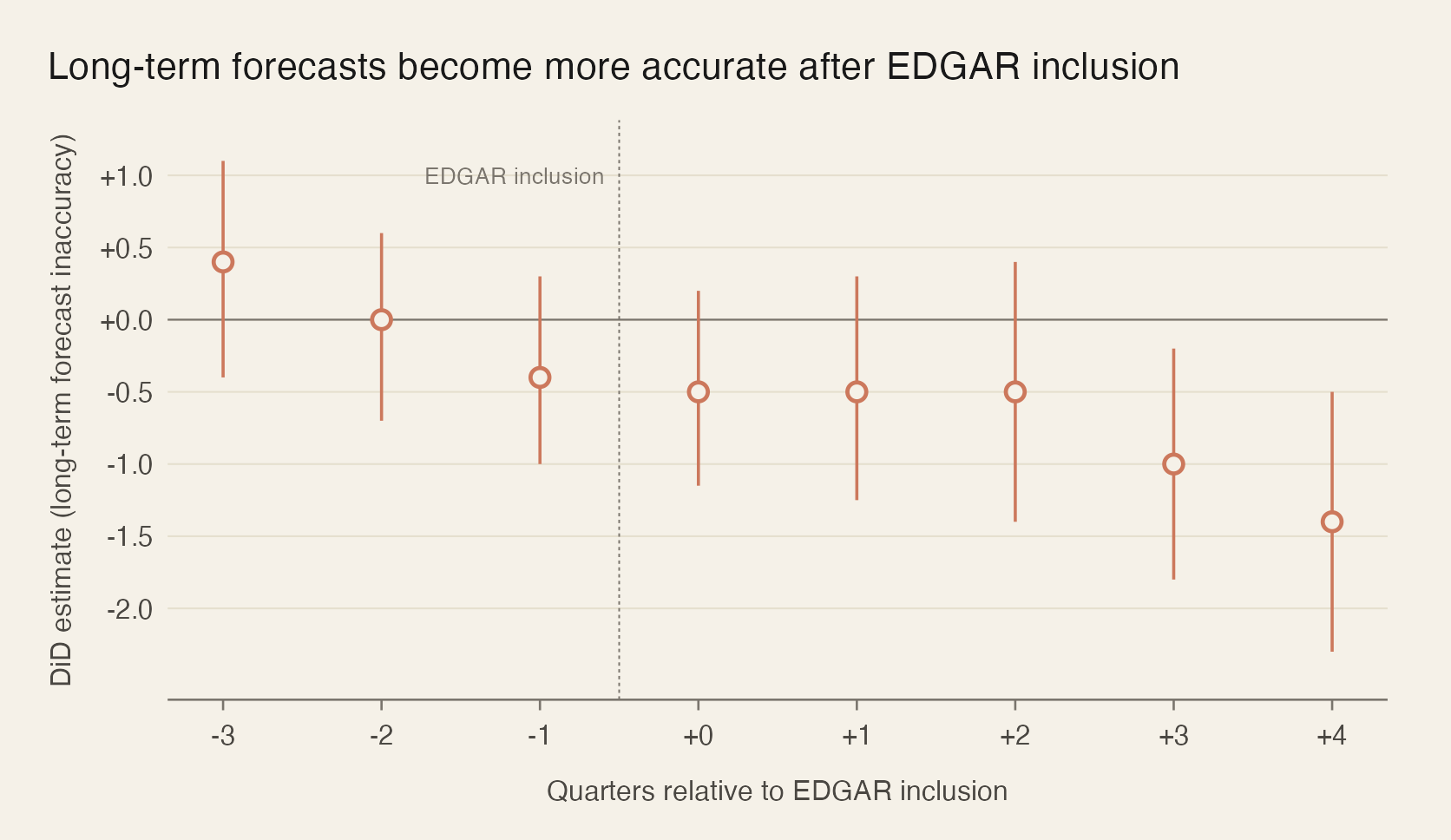
    Dynamic difference-in-differences estimates of EDGAR inclusion on long-term forecast inaccuracy at the analyst-stock level. Pre-period estimates sit near zero; post-period estimates drift downward, with the effect strongest three to four quarters after inclusion.

    The threat of ex-post verification disciplines sell-side analysts: when corporate filings become freely and universally available, analysts' forecasts become less optimistic, more accurate, and less strategically biased.

  4. Access to Financial Disclosure and Knowledge Spillover

    with Tseng & Yu · The Accounting Review Cited by 20

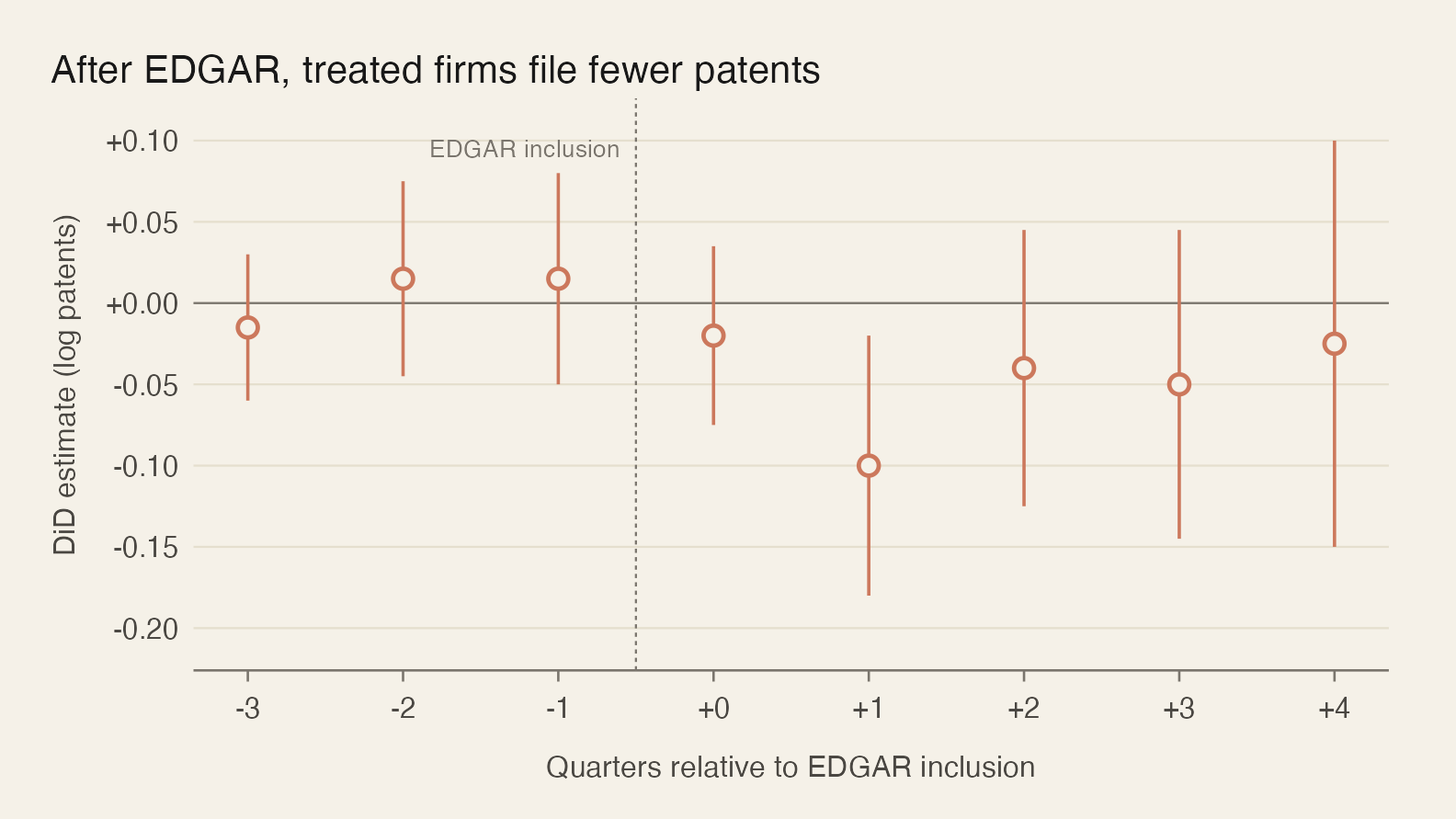
    Dynamic difference-in-differences event study: after EDGAR inclusion, treated firms' log patent disclosures fall relative to matched controls, with the effect growing over the post-treatment quarters.

    When cheaper access to corporate disclosures lets competitors extract more from a firm's patent filings, firms protect their innovations by patenting less and leaning instead on trade secrecy.

  5. Short-Termist CEO Compensation in Speculative Markets: A Controlled Experiment

    with Huang, Su & Tseng · Contemporary Accounting Research Cited by 20

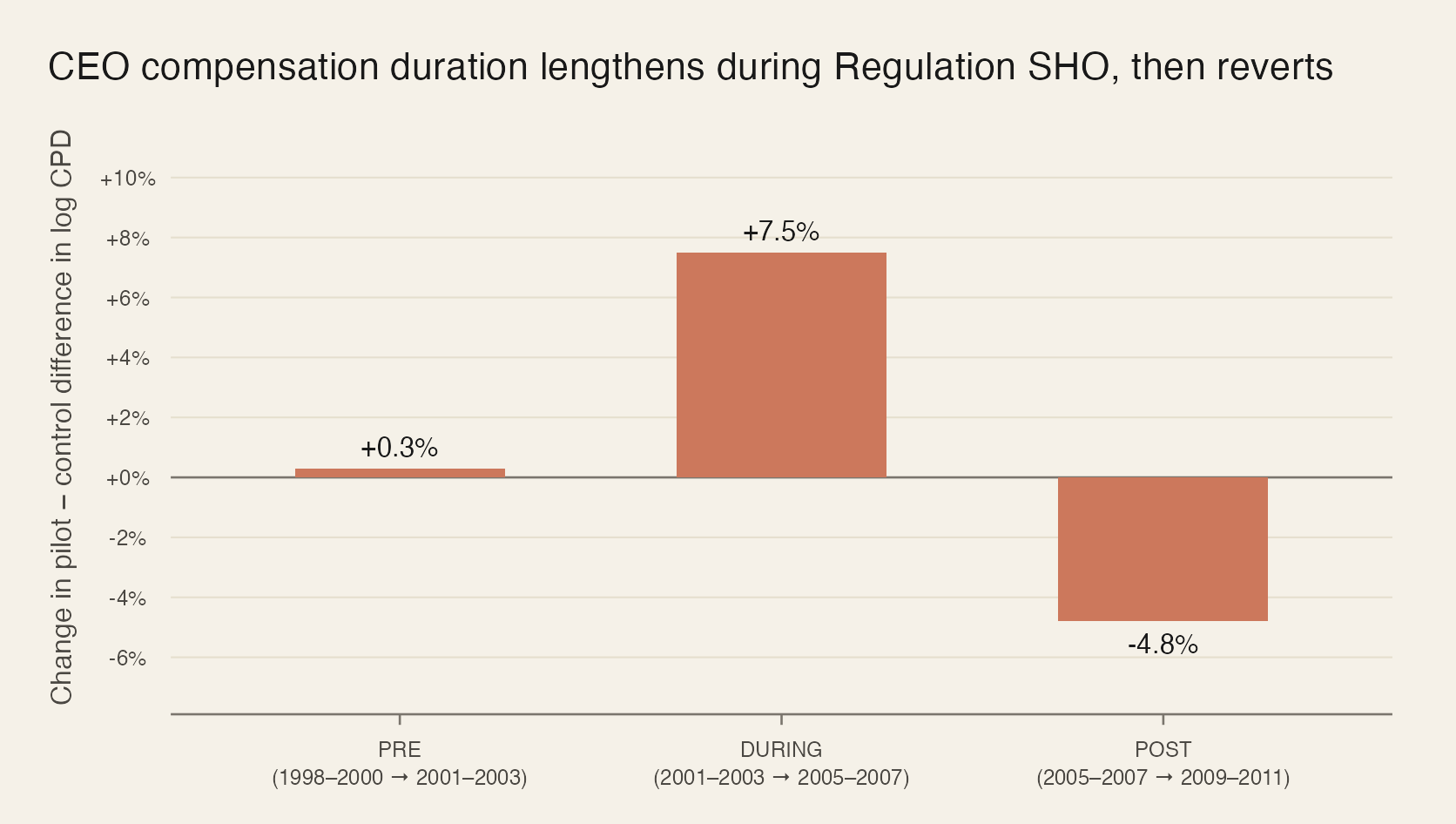
    Bar chart of period-to-period changes in the pilot-minus-control difference in log CEO compensation duration. The pre-treatment change is near zero, the change during the Regulation SHO pilot is a large positive jump, and the change in the post-treatment window reverses most of it — matching the paper's headline DiD.

    Shareholders design short-termist CEO contracts to cash out at inflated speculative valuations; when speculation in a firm's stock subsides, shareholders lengthen the horizon over which their CEO is paid.

  6. Information Environment and Investor Behavior

    with Cheng · Journal of Banking and Finance Cited by 39

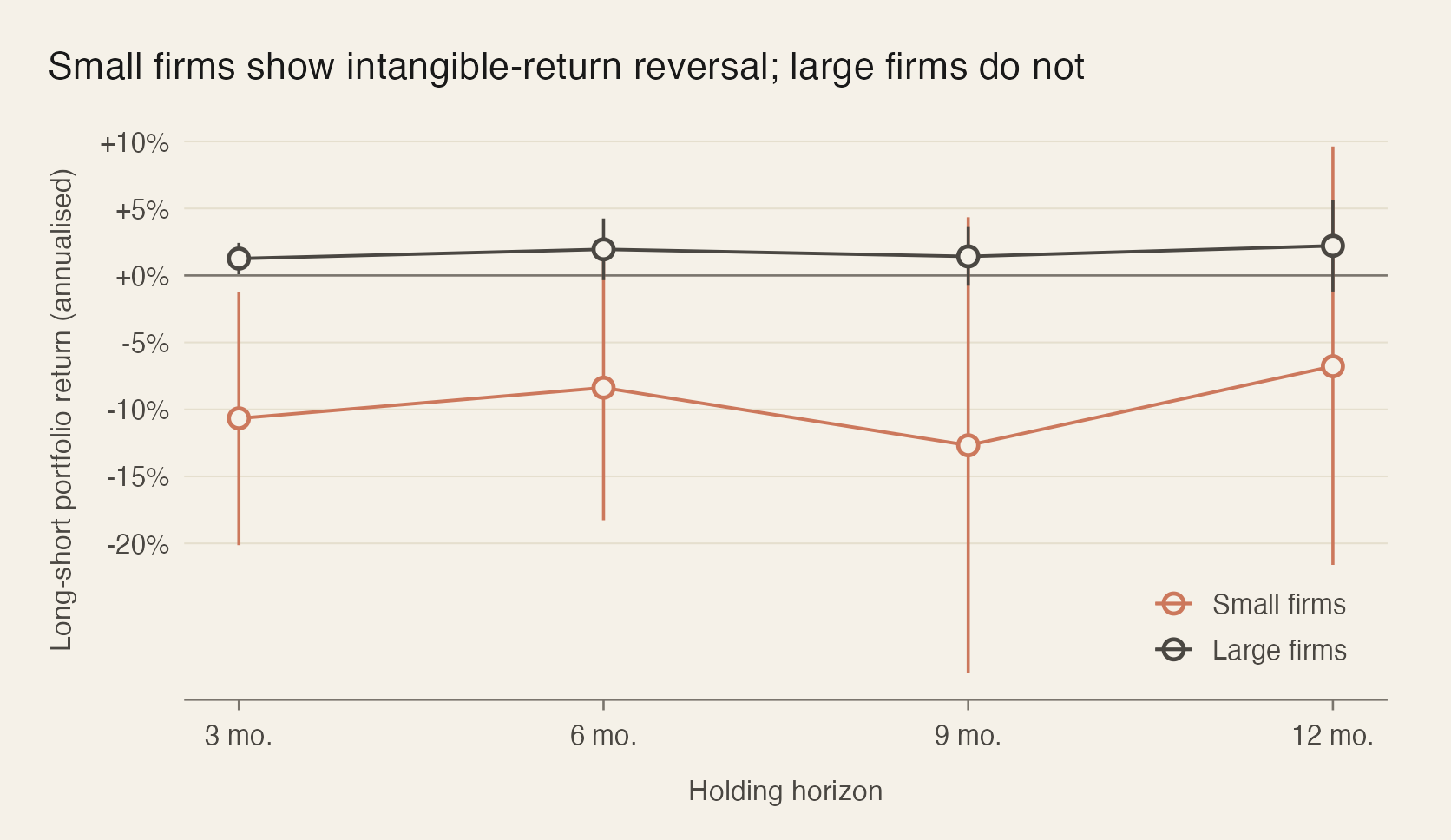
    Annualised long-short portfolio returns from sorting on book-value intangible returns, plotted by holding horizon (three to twelve months) separately for small and large firms. Small-firm returns are sharply negative across horizons while large-firm returns hover just above zero.

    Returns to firms with rich information environments reverse on the prior year's intangible returns — consistent with confirmation bias — while returns to firms with scarce information environments drift, producing sharply different momentum patterns for small and large firms.

  7. Can Stock Message Board Sentiment Predict Future Returns? Local versus Nonlocal Posts

    with Shao & Wang · Journal of Behavioral and Experimental Finance Cited by 12

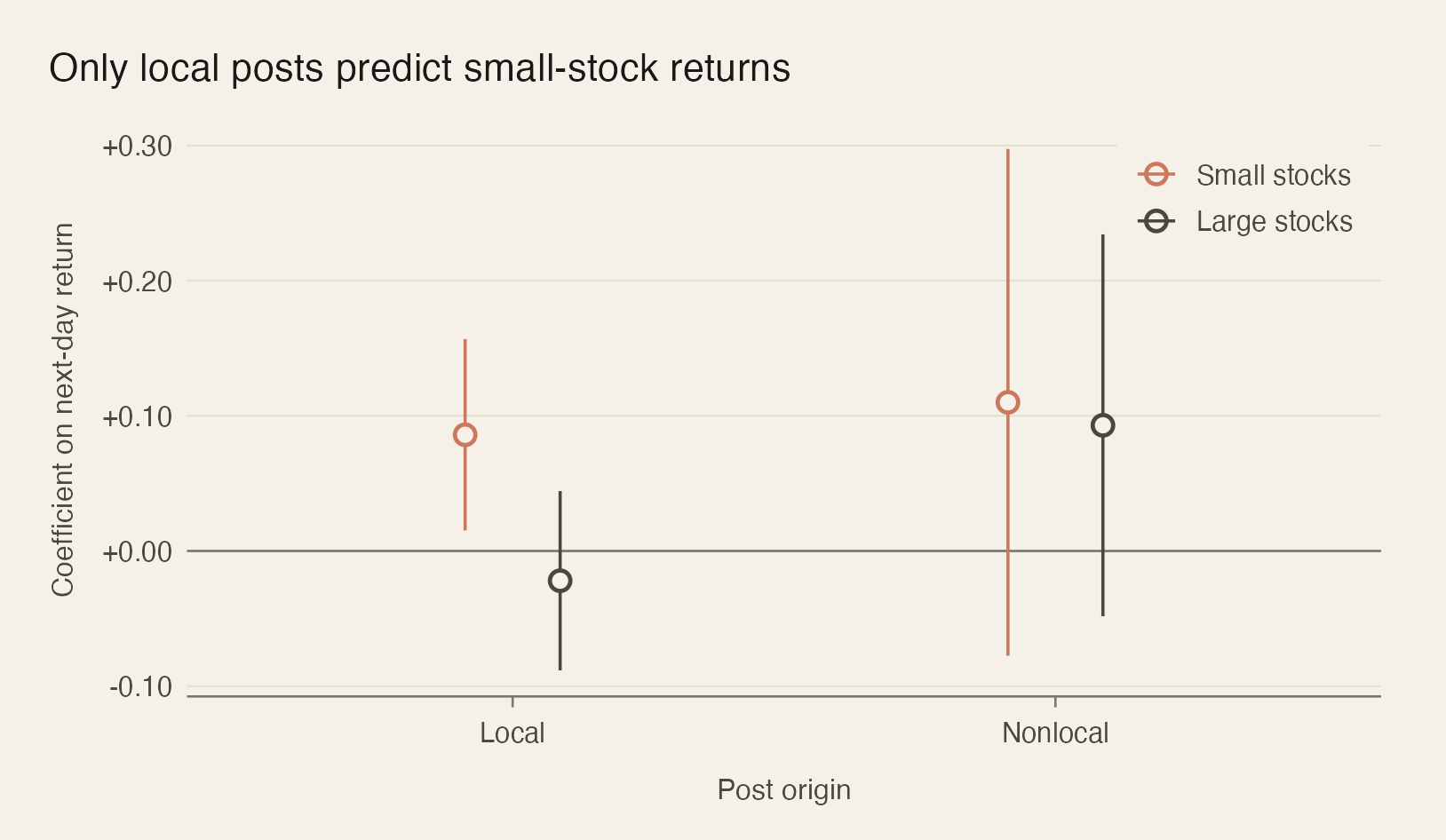
    Regression coefficients of next-day stock returns on message-board sentiment, split by stock size (small, large) and post origin (local, nonlocal). Only local-post sentiment for small stocks is positive and statistically distinguishable from zero.

    Local investors hold a short-lived information advantage about firms headquartered in their home province — only sentiment from home-province posts predicts next-day returns, and only for small stocks where information asymmetries loom largest.

  8. Jump Variance Risk: Evidence from Option Valuation and Stock Returns

    with Chang, Cheng, Peng & Tseng · Journal of Futures Markets Cited by 10

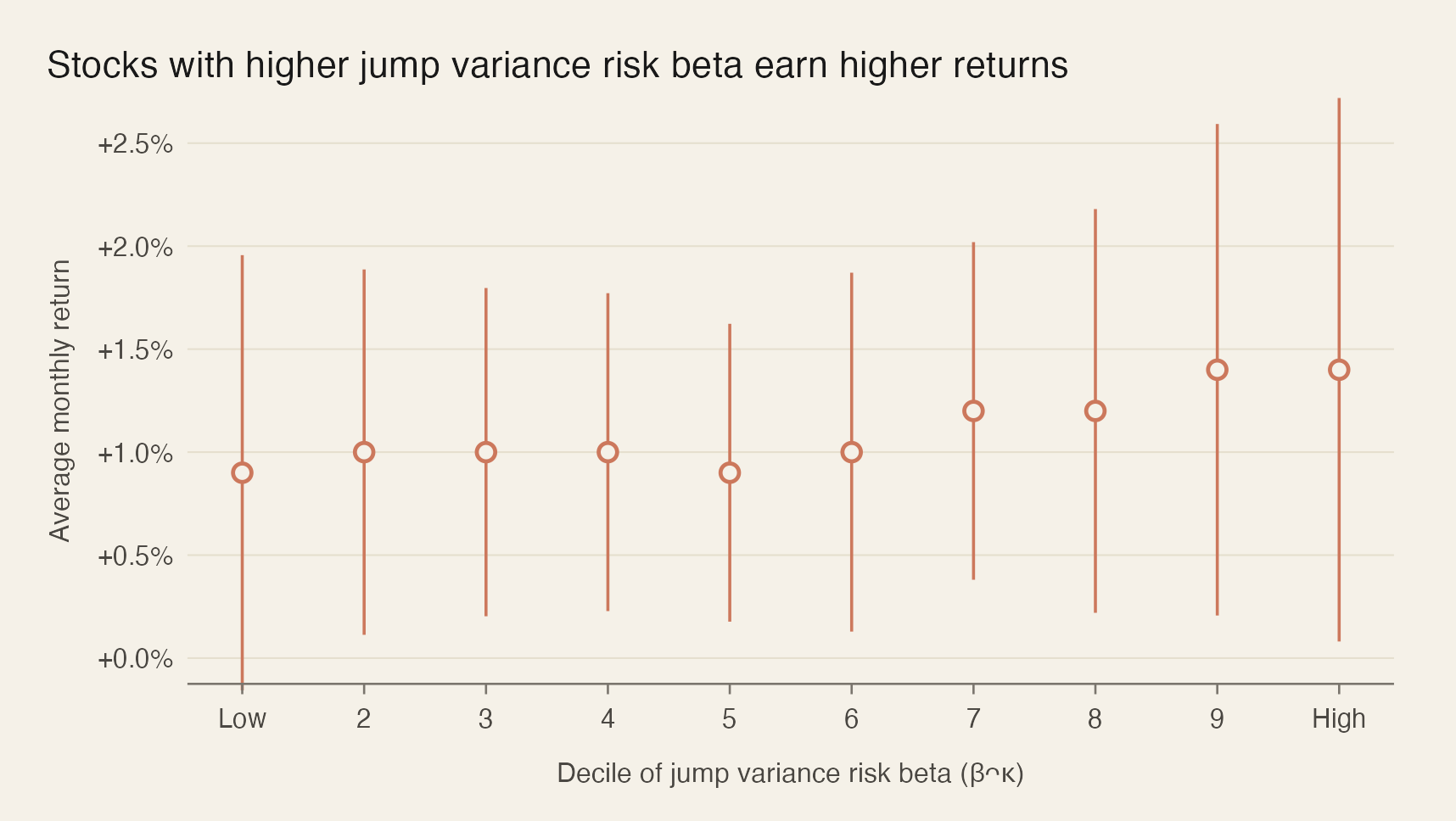
    Average monthly portfolio returns for decile portfolios sorted on jump variance risk beta. Returns trend upward from the low-beta to the high-beta decile, with a high-minus-low spread of roughly half a percentage point per month, about six percent annualised.

    Investors are averse to sudden jumps in market uncertainty and demand compensation for bearing that risk — stocks whose returns co-move most with jumps in variance earn about six percent per year more than the least exposed.

  9. Does Governance Travel Across Industries? A Mutual Fund Episode

    with Tseng & Yen · Journal of Management and Business Research Cited by 1

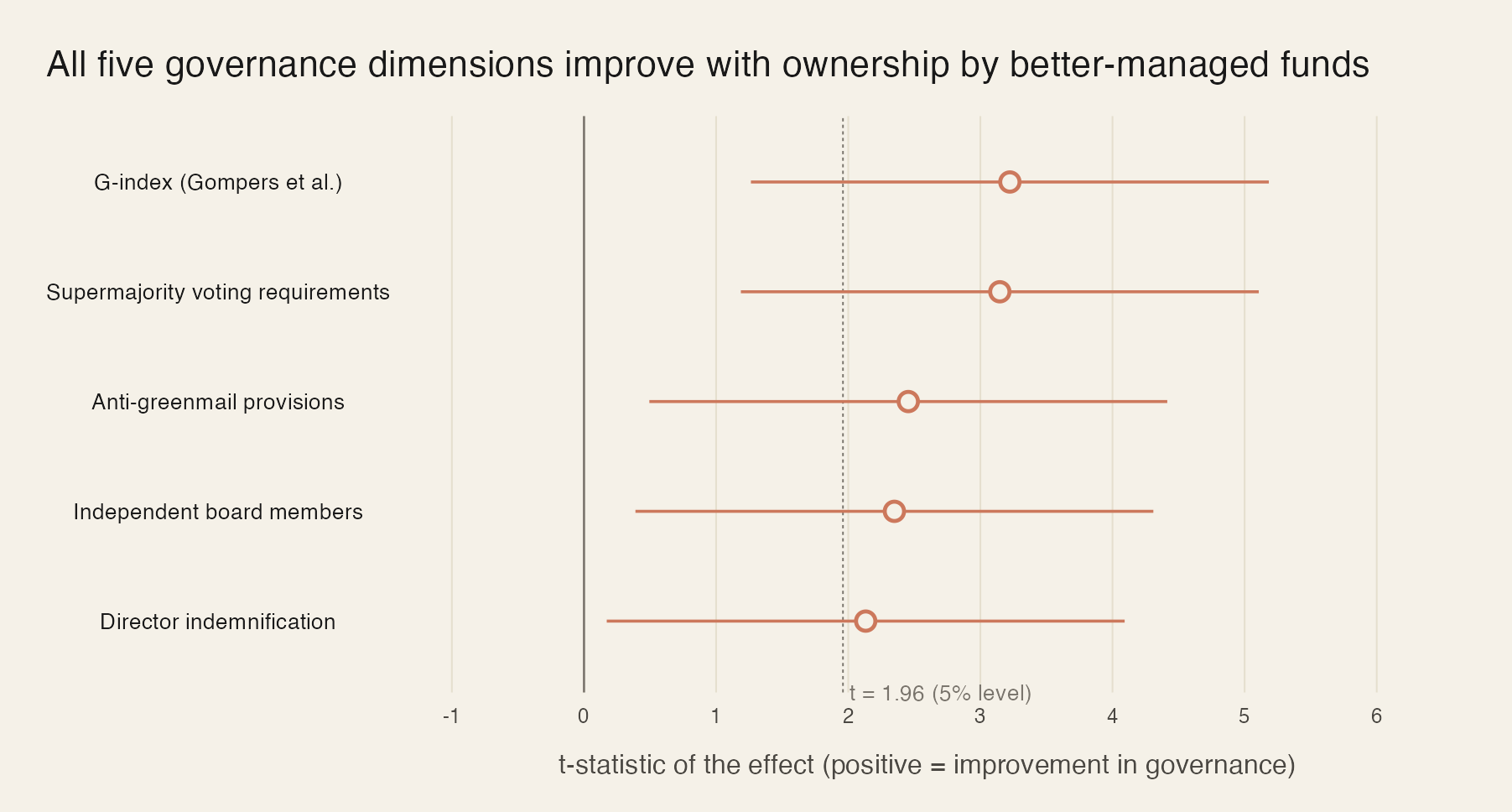
    Forest plot of t-statistics for five governance outcomes after fuzzy-RD instrumentation via Russell 1000/2000 index addition, re-expressed so that positive values indicate governance improvement. All five outcomes have t-statistics that exceed the 1.96 threshold.

    Better-managed mutual funds bring their governance playbook to the firms they invest in — portfolio firms adopt fewer anti-takeover measures, appoint more independent directors, and perform better, suggesting managerial know-how transmits across industries through ownership.

Working Papers

  1. Investor Cultural Diversity and Market Reactions to Corporate Earnings Announcements

  2. Disclosure Acquisition Costs, Volume Reactions, and Differential Interpretations — A Natural Experiment

  3. Learning via the Band of Brothers: Evidence from Entrepreneurship Spillover

  4. When Bad News Travels Faster: Evidence from Disclosure Integration and Post-Earnings Announcement Drift

Awards & Honors

Research

  • NTU Finance Elite Scholar Chair Professorship (2026)
  • NTU Distinguished Academic Publications Award (2025)
  • NSTC Outstanding Research Award (2025)
  • NTU SPE SinoPac Financial Holdings Chair Professorship (2025–2028)
  • E.Sun Academic Award (2022, 2023, 2024)
  • NTU CoM Chen Hong-Mo Chair Professorship (2024–2027)
  • NTU Excelsior Chair Professorship (2023–2026)
  • NTU CoM Research Fellow (2023)
  • NTU Finance Chin-Ren-Shiou Research Award (2024, 2025)
  • Best Paper Award, MTPC (2025)
  • Best Paper Award Semifinalist, FMA (2019, 2023)
  • Best Paper Award, TFA (2018, 2020, 2021, 2024)
  • Best Paper Award, STSC (2017)
  • Best Paper Award, SFM (2014)

Teaching (*English teaching)

  • NTU Distinguished Teaching Award (2025*)
  • NTU Outstanding Teaching Award (2020, 2022*, 2023*)
  • NTU CoM Outstanding Teaching Award (2021, 2021*, 2022, 2024, 2024*, 2025)

Contact

Department of Finance
College of Management
National Taiwan University

yenchengchang@ntu.edu.tw